Luxury vinyl tile is the floor most of our customers end up choosing, and for good reason. LVT gives you the look of oak, slate or limestone in a plank or tile that is completely waterproof, warm underfoot, quiet to walk on and almost impossible to damage in normal family use.
We supply and fit both click-fit LVT, which floats over the existing floor, and glue-down LVT, which is bonded to the subfloor for the most solid result. Both are fitted throughout Preston, Chorley, Leyland, Blackburn and across Lancashire.
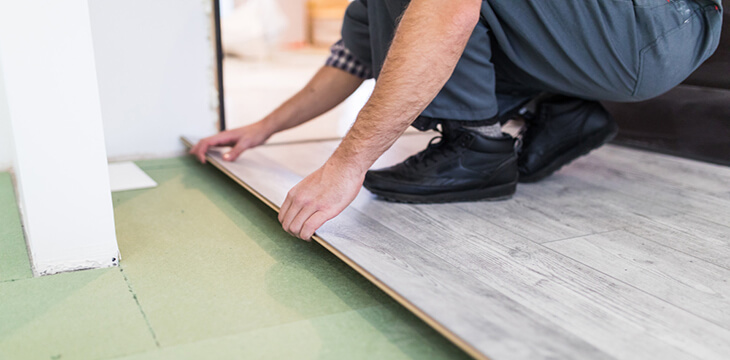
Click-fit LVT locks together like laminate and floats on an underlay, which makes it quicker to fit and simpler to lift later. Glue-down LVT is bonded plank by plank to the subfloor, which gives a thinner, more solid floor with no movement underfoot and lets us lay patterns like herringbone and brick bond properly.
Glue-down needs a genuinely flat base, so it usually comes with latex levelling or a plywood overlay as part of the job. We will tell you which of the two suits your rooms once we have seen the existing floor.
LVT works in almost every room in the house, which is why people often use it right through a downstairs and carry it into the kitchen and utility. If you want the same look in sheet form for a wet room or a bathroom, our vinyl flooring page covers cushioned and safety vinyl instead.
Yes, the plank itself is completely waterproof and will not swell, warp or stain if water sits on it. On click-fit LVT water can still find its way through the joints into the subfloor if it is left long enough, which is why we recommend glue-down for bathrooms, wet rooms and utility rooms. For everyday spills, pets and wet shoes, either type is fine.
LVT is a vinyl product that is waterproof, quieter, warmer underfoot and more flexible; laminate has a compressed wood core that swells if water gets into it. Laminate is cheaper and can look convincing, but it does not belong in a kitchen or bathroom. If the room ever sees water, LVT is the safer choice.
Yes, LVT is one of the best floors for underfloor heating because it is thin and conducts heat well rather than insulating against it. The system needs to be commissioned and the floor temperature kept within the manufacturer's limit, usually 27°C. We will check the specification for the exact range you choose before we fit.
Yes, herringbone and brick bond are both fitted regularly and they look superb, particularly in a hallway or an open-plan kitchen. Pattern work needs glue-down planks and a properly levelled subfloor, and it uses more material and more labour than a straight lay, so expect the price per square metre to be higher.
Usually yes, and it matters more with LVT than with carpet. Because the planks are thin and firm, any dip or lump in the subfloor telegraphs straight through and shows in the light. We use latex levelling compound or a plywood overlay depending on what is underneath, and we include that work in the quote rather than adding it on the day.
A good LVT floor should last fifteen to twenty years or more in a domestic setting. What determines that is the wear layer, measured in microns — around 0.3mm is right for a busy family home, while thinner wear layers suit bedrooms and light-use rooms. Commercial grades go thicker again.
It is one of the best floors you can choose with pets. LVT resists scratching far better than real wood or laminate, claws do not gouge it, and accidents wipe up without staining or soaking in. The textured finishes also give animals better grip than a gloss floor.
Often yes, provided the base is sound, dry and flat. Tile grout lines need filling and floorboards usually need a plywood overlay, because any movement or gap underneath will show through the finished floor. We check the existing floor at the measure and tell you then what preparation it needs.
No, LVT is noticeably quieter than laminate or tile, which is one of the main reasons people choose it. Click-fit systems are laid over an acoustic underlay that absorbs footfall, and glue-down is quieter still because there is no cavity beneath it to drum.
A sweep or vacuum and a damp mop is all it needs, with no polish, wax or steam. Avoid steam mops in particular, because the heat can soften the adhesive on glue-down floors over time. A pH-neutral floor cleaner once a week keeps the finish looking new.
We fit LVT across Preston, Longridge, Chorley, Leyland, Blackburn, Kirkham, Lytham and the surrounding Lancashire towns and villages. See areas we cover for the full list, or ring us if your village is not on it.
contact
Tell us which rooms you are thinking about and we will bring the samples to you, measure up, and put one written price in your hand with fitting included.
Covering Preston, Chorley, Blackburn and across Lancashire