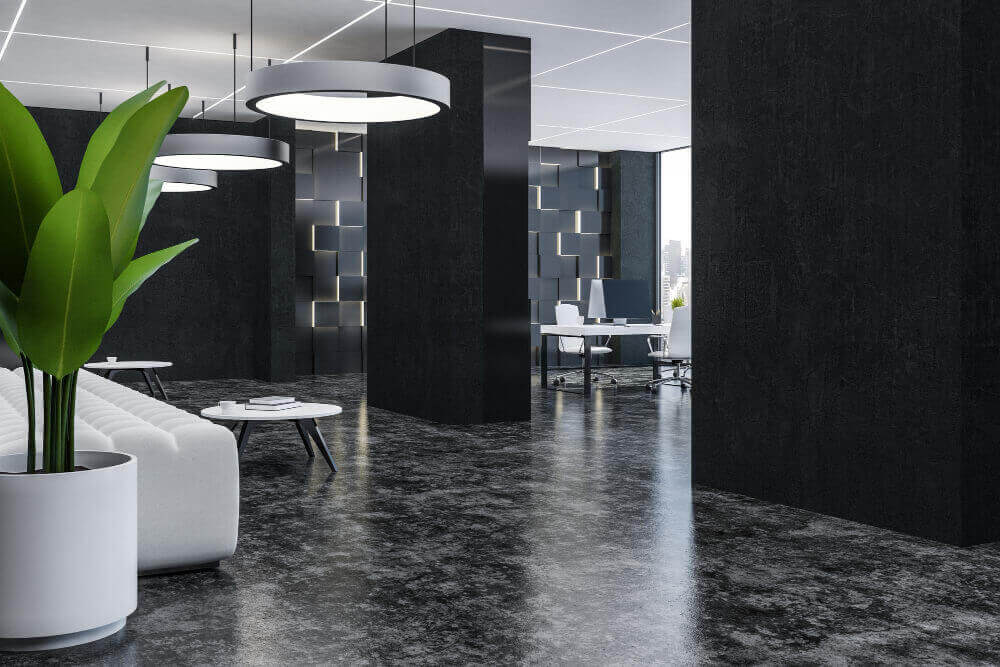
Industrial floors have to survive things a domestic floor never sees — forklift wheels, dropped tools, pallet trucks, oil, solvents and cleaning at pressure. We supply and fit resin and epoxy floor systems for warehouses, workshops, factories, garages and units across Lancashire and the wider North West.
Because these floors go into working premises, the awkward part is rarely the flooring itself. It is fitting the work around production, and we plan around your shutdown rather than expecting you to plan around ours.
Epoxy coatings are the workhorse: hard, chemical resistant and cost effective for warehouse and workshop floors. Polyurethane systems cope better with temperature swings and thermal shock, which is what you need in food production and cold stores. Screed systems go down thicker where the existing slab is damaged and needs rebuilding rather than coating.
Anti-slip aggregate can be broadcast into any of them to hit a required slip rating, and line marking for walkways, racking and hazard zones is applied as part of the same job.
Every resin floor depends on the slab beneath it being sound, dry and properly prepared, so we shot-blast or grind before coating rather than painting over contamination. For lighter-duty commercial spaces such as offices, shops and salons, commercial flooring covers carpet tile and safety vinyl instead.
A straightforward epoxy coating on a sound slab is usually two to three days including preparation and curing. Thicker screed systems and floors needing significant repair take longer. The critical constraint is curing time between coats, which cannot be rushed without compromising the floor.
Not necessarily. We regularly phase work bay by bay, or work evenings, weekends and shutdown periods so production keeps running. Tell us your constraints at the survey and we will build the programme around them rather than the other way round.
Yes, provided the system is specified for it. A thin coating designed for a light workshop will not survive hard-wheeled forklifts and pallet trucks, whereas a properly specified screed or heavy-duty epoxy will. Tell us the traffic and loadings and we will specify accordingly.
It depends on the environment and what ends up on the floor. Dry warehouses often need nothing beyond the base finish, while food areas, wash bays and external ramps need aggregate broadcast into the coating to reach R11 or higher. We will advise on the rating and document what has been applied.
Sometimes, if the existing coating is well bonded and compatible, but it must be mechanically abraded first. Coating over a failing or contaminated floor guarantees the new layer will peel. We take adhesion test samples before quoting a recoat rather than guessing.
The slab is shot-blasted or diamond ground to remove laitance, oil and old coatings and to open the surface so the resin can key into it. Cracks and spalled areas are cut out and repaired. This preparation is the single biggest factor in how long the finished floor lasts.
Not without addressing the damp first. Moisture rising through a slab will push a resin coating straight off. We take moisture readings before starting and, where the readings are high, apply a moisture-tolerant primer or damp-proof membrane as part of the specification.
Yes, including walkways, racking bays, hazard hatching, disabled bays and directional arrows. Applying it as part of the resin installation is far more durable than tape or a later coat, because the markings become part of the floor system rather than sitting on top of it.
A correctly specified and properly prepared resin floor should give ten to twenty years in most industrial settings. Where they fail early it is almost always because of inadequate preparation, an under-specified system, or damp that was never dealt with.
Yes, from patch repairs to potholes and joint arrises through to full resurfacing. Often a localised repair plus a recoat is far more economical than a complete replacement, particularly where the underlying slab is still sound.
We install industrial flooring throughout Lancashire and the wider North West, including Preston, Blackburn, Chorley, Leyland and the surrounding industrial estates. See areas we cover, and get in touch for sites further afield.
contact
Tell us which rooms you are thinking about and we will bring the samples to you, measure up, and put one written price in your hand with fitting included.
Covering Preston, Chorley, Blackburn and across Lancashire